
The current mileage display is one piece of information. Compare it with dated records and the car's identity, and treat discrepancies as questions requiring clarification.
Build a dated record list
Place service invoices, available inspection entries and other vehicle records in date order. Match their VIN or other identifiers to the car.
Do not compare miles and kilometers as if they used the same unit. Keep original entries rather than adjusting a figure to make the timeline look consistent.
Record a date, figure or identity mismatch precisely. A missing invoice and a contradictory reading are different problems.
Ask the seller for supporting documents and have unexplained issues reviewed through the relevant professional or authority. This page cannot verify odometer authenticity from photos or declare a particular display accurate.
Build a dated mileage record before drawing conclusions
Place the current display, service invoices and available history entries in chronological order. Record the date, mileage and source for each item. Confirm that the records identify the same vehicle. A comparison without dates can be misleading, and a copied figure can be mistaken for a new measurement if its source is not clear.
If the timeline contains a decrease or another unexplained difference, ask for supporting evidence and qualified review rather than declaring fraud from a single entry. Share the records with the independent inspector. Physical wear can raise questions, but appearance alone should not be used as a precise mileage measurement. Keep the unresolved issue visible in the purchase decision until the evidence supports an explanation.
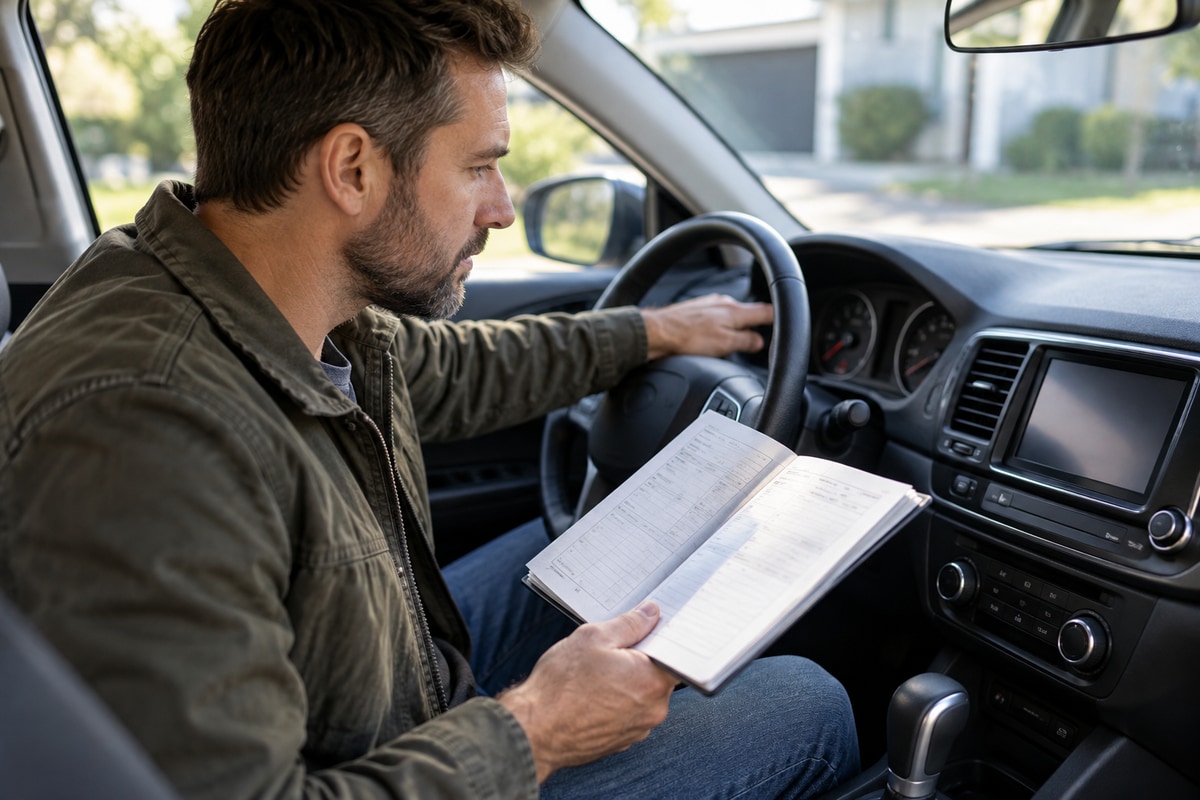
Build a timeline before interpreting a discrepancy
Put each dated mileage record in order and identify its source. Compare the present display with that sequence. If one entry differs unexpectedly, ask for the underlying record and explanation rather than declaring fraud from one number. Unit or transcription differences require clarification; an unresolved discrepancy still belongs in the purchase file.
Use the timeline to prepare questions for the seller and independent shop. The recorded mileage does not price every service or establish the condition by itself. Connect the sequence to the manual and available service records, then retain any professional finding separately in the visit worksheet.
Inspect wear without treating it as a formula
Interior wear and maintenance needs can suggest questions for the inspector, but they do not provide a reliable equation for actual mileage.
Use a shop's observations alongside records. A clean cabin does not establish low use, and a worn seat alone does not prove a specific number was altered.
Save the timeline, explanation and any inspection findings before committing payment.
If the records remain inconsistent, identify that uncertainty in the decision rather than assuming the most favorable interpretation. NHTSA has information on odometer fraud; consult its official guidance for the issue, not a seller's claim that every mismatch is insignificant.
An older entry and today's display answer different questions
A service invoice dated two years earlier might show 45,000 miles while today's display shows 62,000. Those figures can be placed on a normal chronological timeline; they are not conflicting merely because they differ. A later entry showing a lower figure requires clarification. Check date, VIN, units and the original record before deciding what the discrepancy means, and do not invent missing documentation.
At a glance: what to check
| Decision point | Practical check |
|---|---|
| Build a dated record list | Place service invoices, available inspection entries and other vehicle records in date order. |
| Look for specific inconsistencies | Record a date, figure or identity mismatch precisely. |
| Inspect wear without treating it as a formula | Interior wear and maintenance needs can suggest questions for the inspector, but they do not provide a reliable equation for actual mileage. |
| Keep the purchase question open until clarified | Save the timeline, explanation and any inspection findings before committing payment. |
Summary of the checks explained in this article. Keep the document, quote or professional finding beside each item; an estimate is not a completed check.
Questions to resolve before the next step
Can low displayed mileage prove the car is in good condition?
It is one observation. Compare records, use and independent inspection; mileage alone does not establish the vehicle's condition.
Does every mismatch establish odometer fraud?
Investigate the original records and explanation. A discrepancy is a reason to obtain evidence, not a complete finding by itself.
For the relevant official guidance, consult NHTSA: mileage and odometer checks and DOJ: understanding an NMVTIS report. Use each resource for its stated scope; the actual vehicle documents, written quote and applicable jurisdiction still determine the details of your case.