
A test drive helps you observe how a car fits and behaves. Prepare a route and questions, while keeping mechanical diagnosis and unsafe experiments out of the drive.
Arrange permission and conditions
Ask the seller how the test drive will be conducted and what arrangements apply. Choose lawful, ordinary conditions and a route you can navigate without distraction.
Set seating and mirrors before moving. Do not use a public road to test emergency maneuvers or try to prove that a warning symptom is harmless.
Observe entry, seating position, visibility and access to controls. Test cargo fit or family equipment in a stationary vehicle where appropriate.
Confirm which functions the specific trim has, rather than relying on a model name. Record anything you could not check. The purpose is to see whether the unit solves your daily tasks, not to infer equipment from a sales photo.
Plan the drive around questions you can observe
Before driving, note your everyday requirements: seating, visibility, control access, parking space and cargo opening. With the seller's permission and appropriate conditions, use a route that lets you assess those needs. Record what happened and when rather than assigning a mechanical diagnosis to a noise or vibration. A structured observation gives the inspection shop a better starting point.
Check practical fit while the vehicle is safely parked as well as during the drive. Consider whether passengers can enter comfortably and whether the cargo area works for your actual items. Keep a preference, such as seating height, separate from an unresolved operational concern. If operation seems unsafe, stop the test and obtain appropriate assistance; continuing to provoke a symptom is not a useful inspection method.
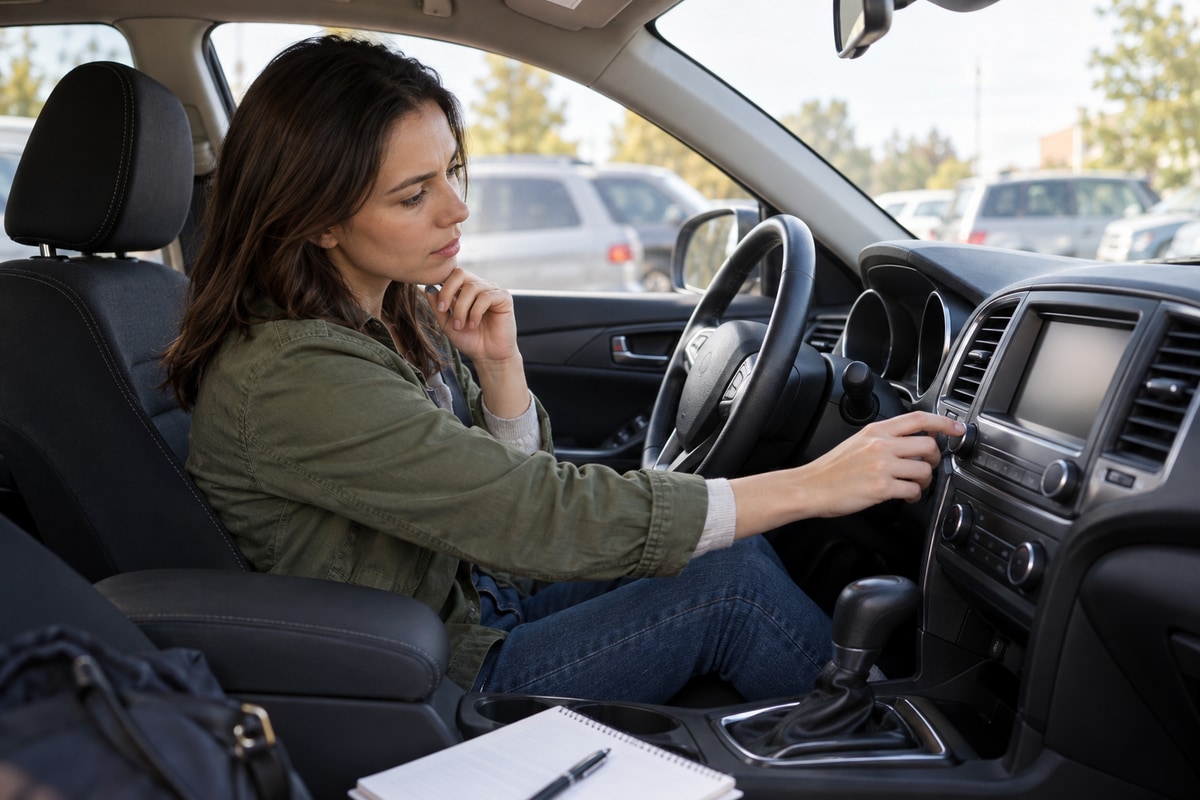
Write the observation before naming a repair
Plan a route you are permitted to use and record observations by moment: starting, low-speed maneuvering, normal driving and stopping. If a sound appears only during a turn, note that circumstance accurately. The buyer's record describes what happened; it does not establish which component caused it or authorize continuing when the vehicle's instructions call for stopping.
Give the observations to the independent shop with the VIN and ask what inspection scope addresses them. Record the professional conclusion and estimate separately. Comparing two vehicles becomes more useful when each has a dated observation record instead of a general “drives fine” impression.
Describe what you notice
During a normal drive, note unfamiliar noises, vibrations, warning messages or changes in operation when safe to do so. Describe location and circumstances instead of naming a failed part.
Stop using the car and seek the seller's or professional's assistance if a condition seems unsafe. A symptom that disappears briefly is not evidence that a repair is unnecessary.
Give the shop your notes and ask whether further diagnosis is needed. Match them with records and the written purchase proposal.
A comfortable test drive does not replace inspection, VIN checks or title review. If there was no opportunity to test a relevant feature, retain it as pending rather than marking every item acceptable because the seller was in a hurry.
A useful note describes the condition
Instead of writing transmission failure, record a hesitation noticed once under a stated driving condition, then ask the independent shop to assess it. Instead of SUV too large, record that the candidate does not fit your usual parking space with enough access. The first observation needs technical assessment; the second can directly affect the practical shortlist. Both are more useful than a confident label without supporting information.
At a glance: what to check
| Decision point | Practical check |
|---|---|
| Arrange permission and conditions | Ask the seller how the test drive will be conducted and what arrangements apply. |
| Check fit while parked | Observe entry, seating position, visibility and access to controls. |
| Describe what you notice | During a normal drive, note unfamiliar noises, vibrations, warning messages or changes in operation when safe to do so. |
| Take observations to an inspector | Give the shop your notes and ask whether further diagnosis is needed. |
Summary of the checks explained in this article. Keep the document, quote or professional finding beside each item; an estimate is not a completed check.
Questions to resolve before the next step
Can a short test drive prove the car is mechanically sound?
It provides observations under limited conditions. Use an independent inspection and the vehicle's records for the broader assessment.
Should I drive until I reproduce an unsafe symptom?
Do not turn the test into an unsafe experiment. Stop and seek qualified help when operation raises a safety concern.
For the relevant official guidance, consult FTC: buying a used car from a dealer and FTC: auto repair basics. Use each resource for its stated scope; the actual vehicle documents, written quote and applicable jurisdiction still determine the details of your case.